I am very happy to have this collection of images presented in a comprehensive article on my work by Dodho Online Magazine: Photographers Around the World.
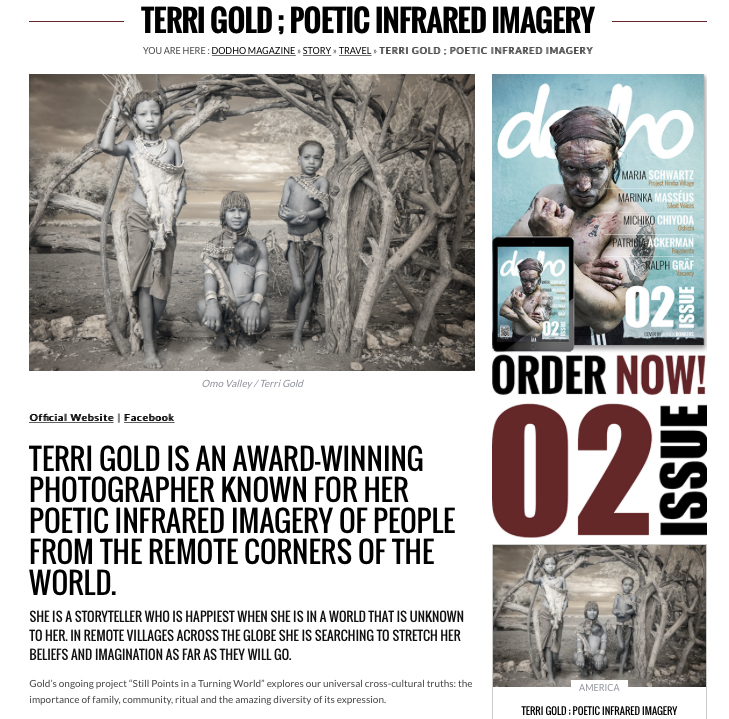


Click here to read the full article.
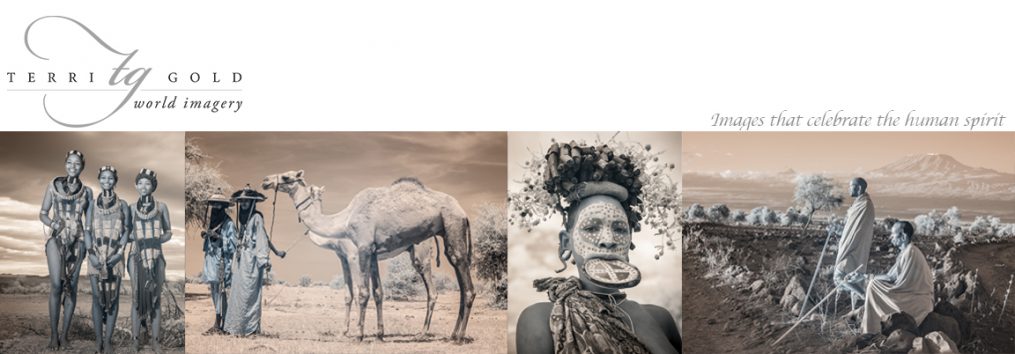
I am very happy to have this collection of images presented in a comprehensive article on my work by Dodho Online Magazine: Photographers Around the World.
Click here to read the full article.

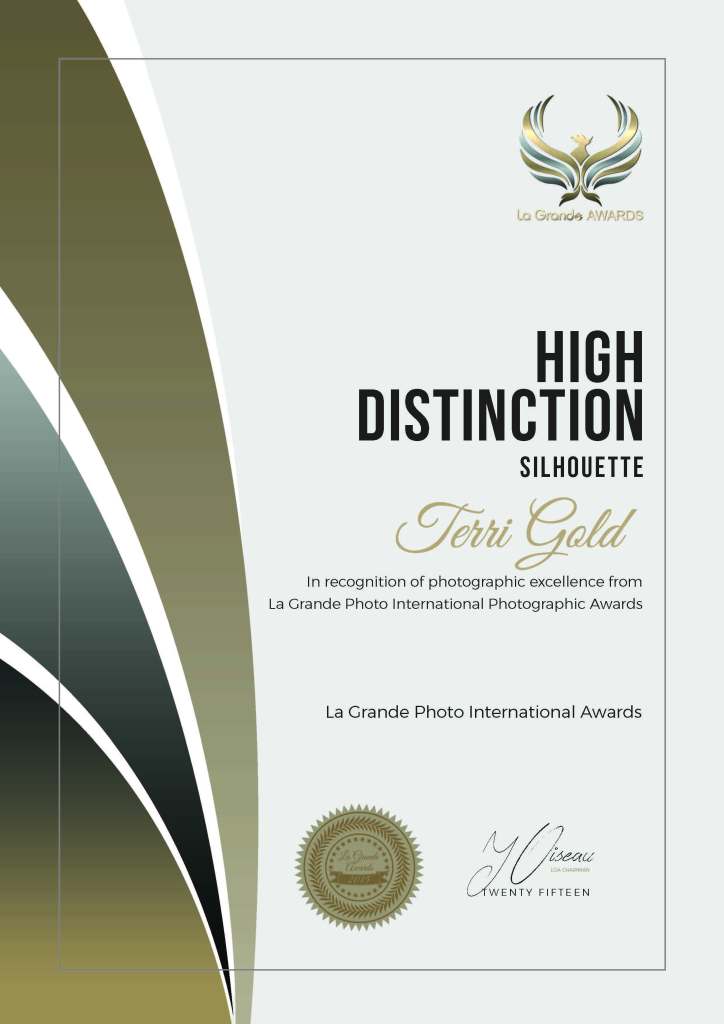
Thrilled to receive honorable mentions for these two series in the 2016 International Photo Awards.
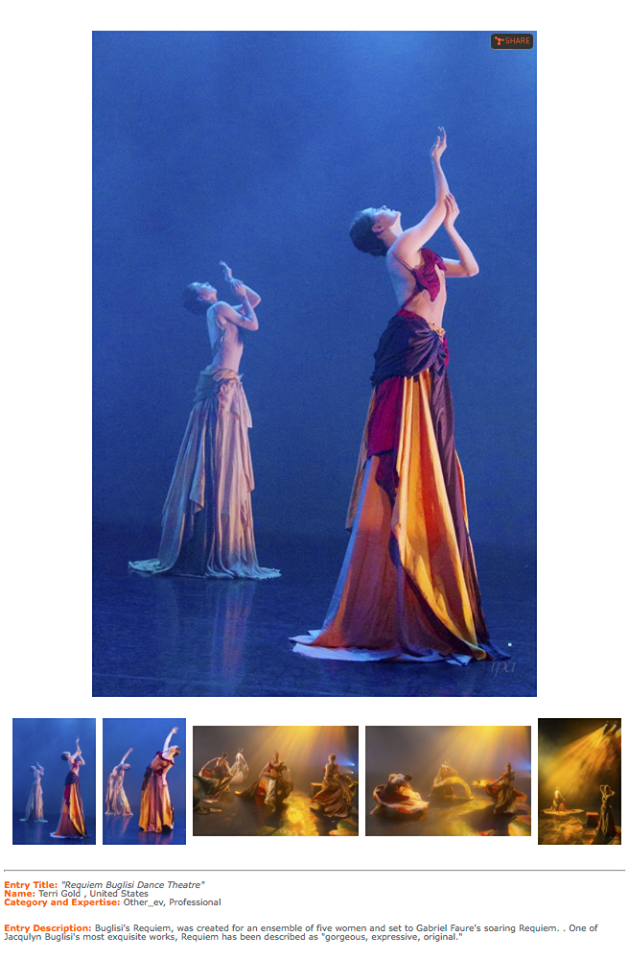
Honorable Mention – Requiem Buglisi Dance Theatre

View more about the awards and competition here.


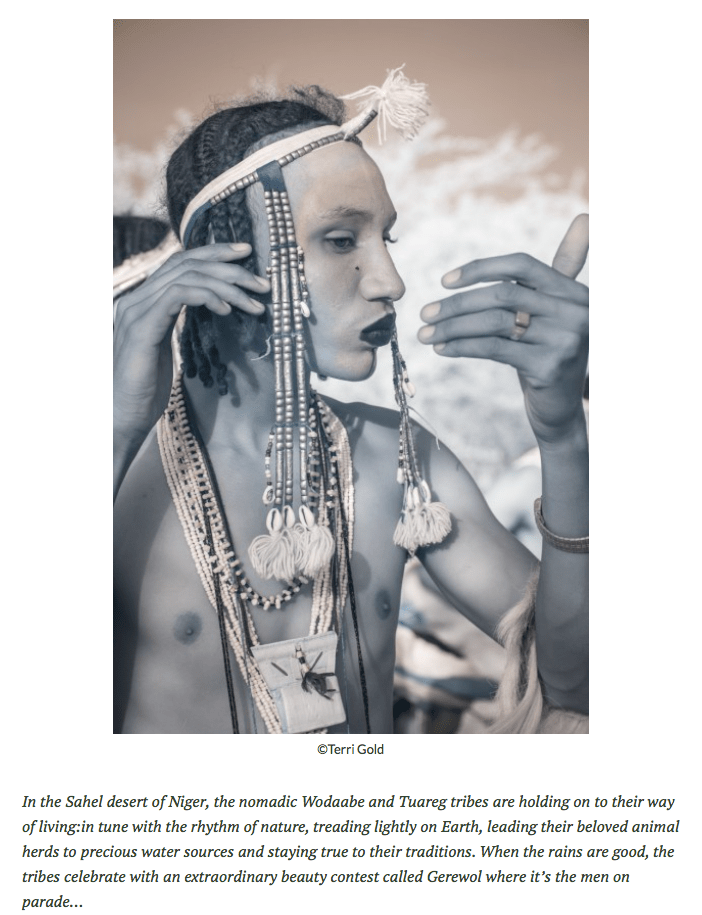
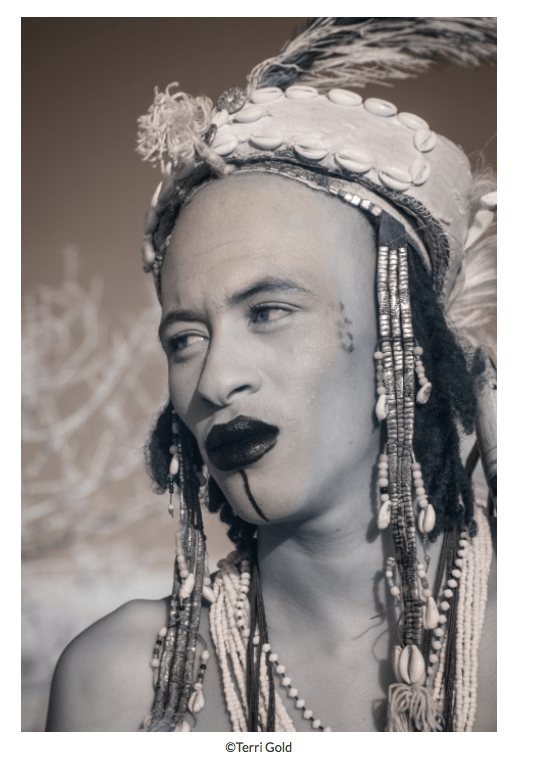
MAGICAL COMMUNION One friend told her she was crazy; another said she was insane. Others were even less kind. “I didn’t really blame them for telling me I was nutty to travel to Niger in West Africa in 2013,” says Manhattan- based Terri Gold. “After all, Ebola had recently broken out and the U.S. State Department was warning against traveling to much of the country.” The Peace Corps and other NGOs had already pulled out of Niger due to threats from extremist groups such as Boko Haram. But Gold was unfazed. The globetrotting photographer had already traveled to Rajasthan, India; the Omo Valley, Ethiopia; Lhasa, Tibet; Kham, China, and a slew of other hard-to-reach, often dangerous places to document what she calls “cross-cultural moments in time” and “the unguarded moment.” Ever since she’d seen photographer Carol Beckwith’s 1983 book, “Nomads of the Niger,” she’d wanted to visit the landlocked country, hoping to photograph the Wodaabe nomads as they celebrate their annual weeklong courtship ritual, the Guerewol Festival. “I’m pretty stubborn once I’ve set my mind on doing something,” explains Gold. “Besides, this was a once-in-a-lifetime kind of trip.”
 GREATER RISK, GREATER REWARD That said, an email from the trip’s Africabased organizer did give her pause. “She was writing to reassure us,” remembers Gold, who planned to travel to Niger with two other photographers. “She told us, ‘Don’t worry. We will have 20 armed guards with .50 caliber machine guns to accompany us, and it would take a multi-vehicle convoy to attack us.’” Gold pauses and adds, “We talked about calling off the trip but this was too good an adventure to cancel.” Her persistence and courage paid off. The remarkable images she captured during her three-week adventure have earned her numerous national and international awards and have been reprinted in online media, including the Huffington Post and the BBC. But more important to Gold is that they’re the latest contributions to her lifework, a yet-to-bepublished series of ritual and celebration photographs she’s made all around the world, dubbed “Still Points in a Turning World.” The collection’s T.S. Eliott-inspired title refers to rituals and moments that tie all people together, she says. Gold began her photography career shooting weddings and was intrigued by how vulnerable people acted during what she calls “grace moments.” “I loved capturing people’s emotions and how they were feeling during these special, unguarded moments,” she says. “I am not showcasing otherness, but rather providing a window on our common humanity.” Gold has exibited her work in Spain, San Francisco, Los Angeles, New York City, Colorado, Vermont and at the Annenberg Space for Photography. She’s preparing for more exhibitions this year. Recent awards include the International Photography Awards, Prix de la Photographie Paris, Humanity Photo Awards, and the Black and White Spider Awards.
 UNDER THE SPELL Since childhood, Gold has been fascinated by explorers such as Mary Kingsley, Isabella Bird, and Alexandra David-Neel, intrepid women who traveled to foreign lands to report on cultures and traditions. When Gold herself began traveling, first to Asia in the late 1980s, she noticed a common humanity among various cultures. “While we may have our bar mitzvah, a foreign tribe may have a bull jumping ceremony,” Gold says. “These rituals look different, but the values are the same. We laugh and cry at the same things. I wanted to try to capture that on film.” She began visiting parts of the world that fired her
  imagination and brought along her camera gear. “While friends were going to Paris or London, I was more interested in setting off for those curious corners of the world, such as Timbuktu or Rajasthan—places that seemed to me to be steeped in mystery and intrigue.” She admits these self-assigned trips could be expensive, but because she has no children to support, “I am free to follow my own passion.” That passion included a desire to highlight the mysterious side—what she terms “the magic realism”—of the places she visited. She’s long used infrared film and knew it could give her that special quality she sought. “I like the way infrared pierces the veil; it has an invisible iridescent quality, a shimmer to it. It illuminates another dimension,” says Gold. “I thought it was the perfect film for these parts of the world where there is so much mystery.” Using infrared harkened back to her days as a lith printer, a process she learned at Manhattan’s International Center of Photography in the 1990s. “With lith printing no two prints were the same,” says Gold. “I liked the sense of discovery it offered. It was always a dance in the darkroom.” Infrared film offers her a similar surprise element. “Infrared gives you the mysterious right away. It also sees things you don’t see,” says Gold. “You don’t know exactly where the colors are going to fall. For example, you do know the green leaves are going to turn slightly white but it all depends on how the sun is hitting the leaves. It’s the same with water. It’s impossible to pre-visualize with infrared. “Many of my early photography mentors talked about the necessity of pre-visualizing your work, but that did not work for me. I want to go on a journey with my photographs and want to be surprised. I love the unexpected.”
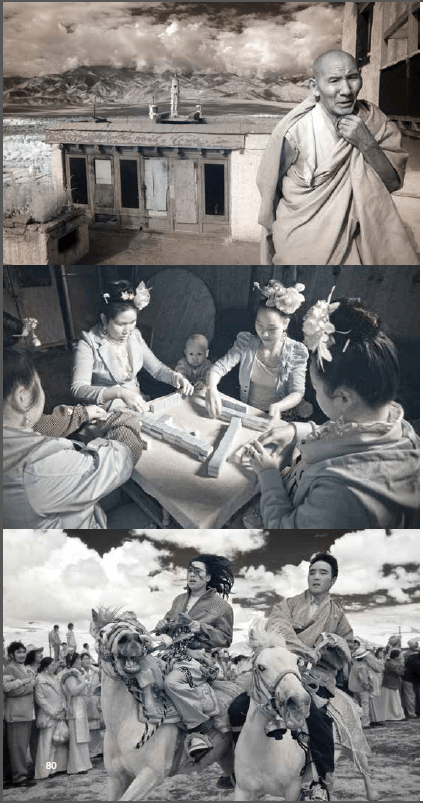 Inspired by a friend’s photograph that had been painted, Gold began painting on her own prints, often adding encaustic wax. She sometimes uses extensive post-processing and is fond of split toning. “Taking pictures is just the beginning for me,” says Gold. In the pre-digital days Gold had to carry four to five cameras—everything from several 35mm cameras loaded with regular and infrared film to a Mamiya and a Hasselblad and film changing bags. “I would freak out at airports and beg the customs people not to open my infrared film canisters. Now it’s a lot easier, and I travel with converted infrared digital cameras.” She usually carries a Canon EOS 5D Mark III. “Digital has freed me up so much,” says Gold. “I have more freedom in aperture, exposure, and shutter speed. And now for the first time with infrared I can get some idea of what I am shooting.” Gold captures almost all her subjects in infrared but admits, “It doesn’t always work. I know it has its limitations, but I always give it a try. I always also have a color camera along with me.” If making memorable photography is about capturing a moment, then Terri Gold’s trip to Niger is a life lesson in the importance of making those moments happen. As she readily admits, it would have been very easy for her to cancel her trip because of all the perceived dangers. “In fact, a week or so after we left Niger, al-Qaeda rebels spilled over into the country from Libya,” she says. “If we had cancelled or delayed our trip, we never would have gotten back there.” But she didn’t cancel. She braved 110-plus degree Fahrenheit heat to document a ceremony in one of the world’s most remote deserts and returned with powerful images. For all the travel warnings, her trip went smoothly. “Any worries about violence and unrest disappeared during our time amongst the welcoming Wodaabe, especially when we camped under a tapestry of the Milky Way accompanied by the chanting of the nomads and the lullabies of their animal herds.” While she hesitates to describe herself as brave, she says she now understands completely the Wodaabe adage she learned on her trip: Who cannot bear the smoke will never get to the fire. • terrigoldworldimagery.com
Robert Kiener is a writer based in Vermont.
 Infrared Photographer Terri Gold
Award-winning, fine art photographer and creative nomad Terri Gold captures her beautiful, other worldly photographs of tribal and nomadic cultures and their rites using invisible light. This light which cannot be seen exists on the invisible part of the spectrum and is captured by infrared sensitive film to reveal a enchanting and poetic under-layer. At home in unfamiliar lands, the wanderlust fueled photographer lives a surreal existence where time and centuries coexist. As an outsider, Gold’s ability to tap into foreign worlds with such an intimacy whilst also emphasising the mystery encapsulated within their rituals and ceremonies is an impressive balance. And her talents are held in great esteem within the photography and creative worlds.
Traveling across oceans, deserts and deep into the bush with up to three cameras in tow along with an ever growing passion and wanderlust, Gold is seeking to shine light on the fragility of tribal cultures seemingly untouched by time; using a light that cannot be seen with the naked eye.
CM: Your work has been published in numerous digital and print outlets, what first garnered notice of your work?
I think the global response to my work speaks to the universal connection that all humans share. The loss of diverse cultures and species is becoming inextricably connected with the development of the modern world. The cultural diversity of our planet is where our greatest creativity lies. Though we may not see our own customs and traditions in these images, it is my hope that we recognize our common humanity. Our challenge now is to keep the poetry of diversity alive…
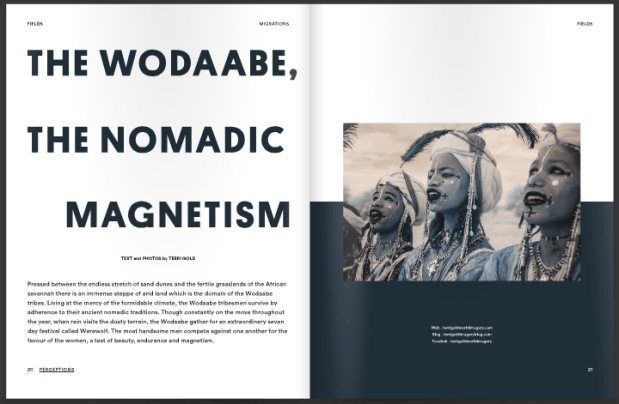

I am honored to have my work featured in the Fields Magazine #ALLMIGRANTS issue, which explores the theme of modern migration through images and stories.
The brain-child of Saran Koly, #ALLMIGRANTS is full of fearless storytellers and soulful adventurers, and “dedicated to all the people who have refused to be the victims of an unfair system and decided to take their destiny into their own hands”
Below are a few glimpses of the gorgeous print publication, available for purchase at www.fieldsmag.com (Web publication to follow soon!)
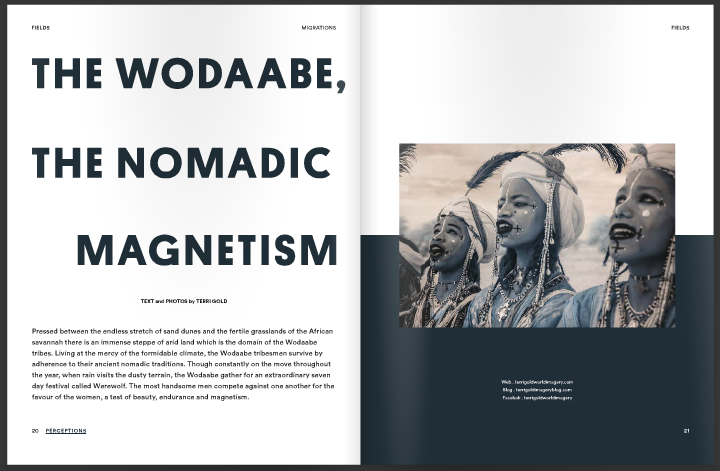

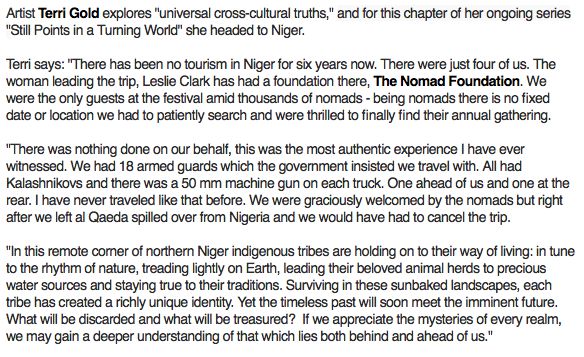
Images from my Nomads In Niger series are now featured on The BBC Picture Desk.
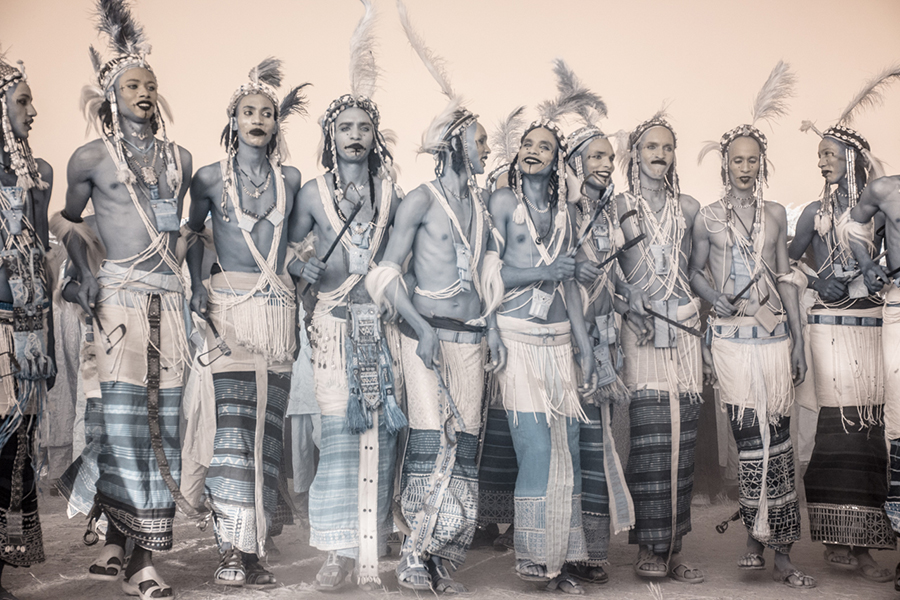 “I was blessed to share time with this incredibly unique group of people and to learn about their cultural traditions, communal values and ethical perspectives”
I see more than ever the importance of sharing our stories to gain a deeper understanding of the timeless past and the imminent future. The cultural diversity of our planet is where our greatest creativity lies. Our challenge now is to keep the poetry of diversity alive…
The BBC feature can be viewed here.
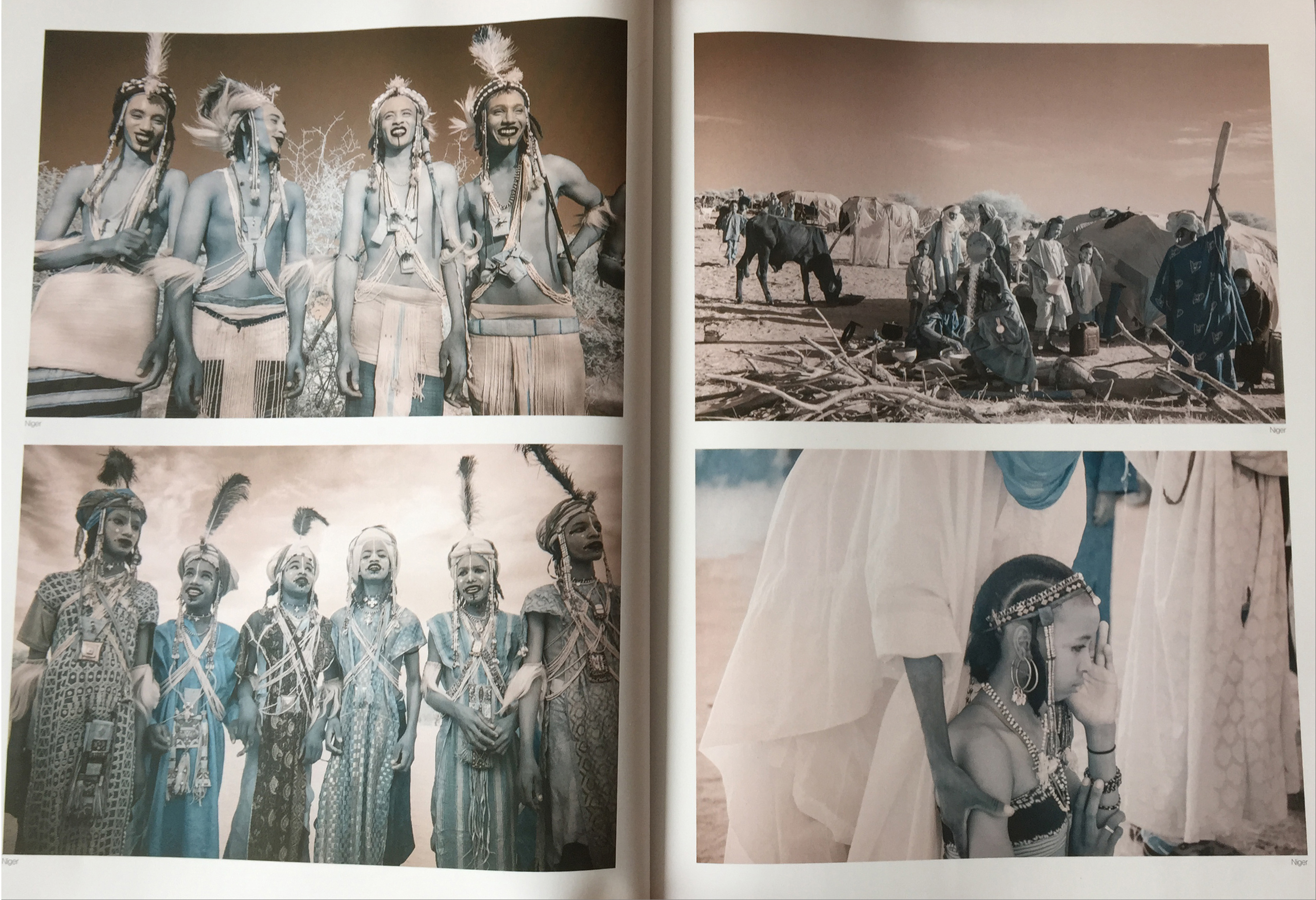
Terri Gold’s images from the Nomads in Niger series and the Omo Valley of Ethiopia series were just published as a three page spread in Photo+ a prestigious Korean photography magazine. Both featured image series are from Terri’s ongoing body of work “Still Points in a Turning World”.
Excited to be turning the glossy magazine pages of the Photo+ Magazine feature of my images from Africa! It is nice to have your work embraced by an international photography community.
.



Photography Views . Reviews . Interviews
Nevada Wier is an award-winning travel and fine-art photographer specializing in the remote corners of the globe and the cultures that inhabit them. Enjoy her musings, creative tips, and practical suggestions. Excelsior!
Clap sur l'actualité culturelle africaine
Travel inspiration, stories, photos and advice
danielC Portfolio.
This is the art, mind, and technology blog by Tullio DeSantis
Published by Sarainés Kasdan
with audrey michelle
Creativity is within us all
Painting, Photography, Video
E-Magazine for collectors, photographers and gallerists
Photography and me.

 Terri Gold World Imagery